A woman’s wardrobe is an exciting sea of clothes and accessories in the preferred styles of its owner. At the same time, an unfailing fashion icons will always be found and have a place here.
One such icon, together with the little black dress, is the white shirt.
According to Harper’s Bazaar the white shirt is ‘one of the most perennially stylish items in a woman’s wardrobe’.
(De Klerk, 2020)
On the other hand, Hagman is a bit more philosophical, presenting the white shirt as “a neutral surface” and therefore that as a garment it serves the purpose of a canvas ‘against which the wearer’s individuality will emerge’.
(Hagman, 2013)
Whether we look at it more philosophically, creatively, or practically, the white shirt is an item that became one of the most trend-less and timeless pieces of clothing within anyone’s wardrobe, be that a man or a woman, due to its rich cultural history, its presence within significant fashion and film moments, but most of all its ability to ‘muddle the habitual codes of fashion, and gender’
Throughout antiquity the shirt in its different incarnations (the Egyptian kalasaris, the Greek chiton, the Roman tunica manicata) is a unisex undergarment, where whiteness symbolises wealth, integrity, honesty, and respect. In the Middle Ages, became exclusively a man’s garment.
Used as men’s underwear in the Middle Ages, woven from linen or cotton, it was use as a protection for noblemen’s outerwear. In the lower classes the white shirt was used as a main garment. At the same time, in many countries and cultures, the white shirt became an invariable part of men’s and women’s national costumes, where it was worn decorated with embroidery or simply fastened with a belt.
Gradually, the white shirt acquired lavish embroideries or laces (XVI century), additional sets and gathered lace fronts (the so-called ruffle – XVIII century), and at the beginning of the XIX century it also started to be represented in different colours.
The inclusion of the men’s white shirt as part of the women’s wardrobe occurred in America and Western Europe in the 1860s. During the First World War the shirt in its more feminine form becomes a wardrobe staple for European women. By the 1920s Hollywood starts and designers like Coco Chanel had blurred the boundaries between class and gender, this led to the adoption of the white shirt within women’s fashion and envisioning it as a symbol for emancipation of the working independent woman.
By the 1940’s the garment achieved further prevalence through figures like Louise Brooks, Marlene Dietrich, Ava Gardner and Katherine Hepburn (Holiday 1938).
The white shirt became a juxtaposition between masculinity and femininity
It was later that the white shirt developed more of an androgynous presentation through icons like Patti Smith and her Horses album cover, Kim Basinger, Uma Turman, and films like Pretty Woman. This is the beginning of the white shirt as a unisex element in the world of fashion.
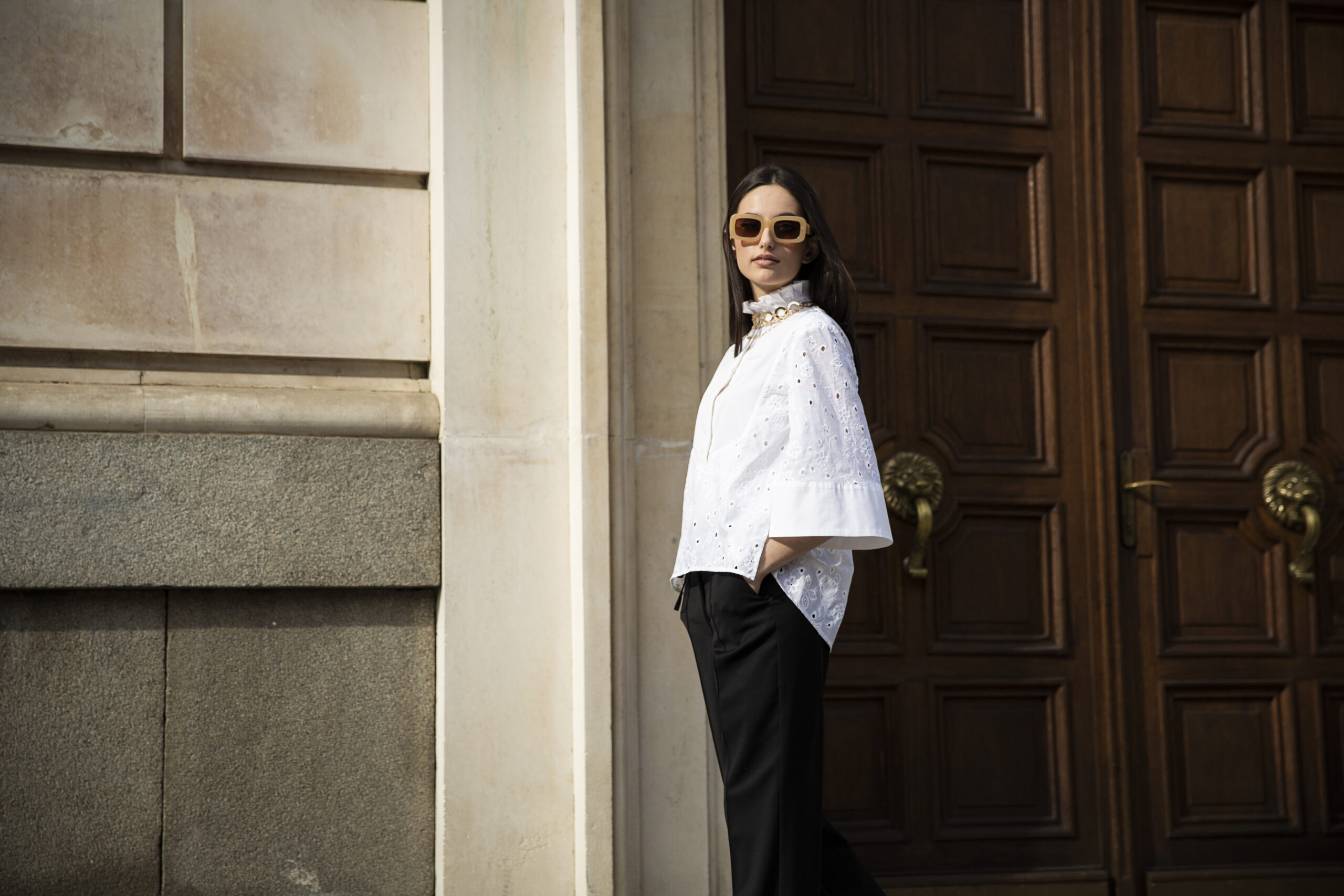
As a boutique brand, at ANIKO&BO we know that femininity has no boundaries and has many faces. For that reason we would always offer the white shirt to your attention. With its rich variety of cuts, fabrics, lengths, design solutions, and refined silhouette it allows for endless dressing possibilities.
Whether in a combination with a pair of jeans, or skirt, a suit, or evening look – it makes everything more stylish and refined.
But the secret of how to wear the white shirt lies in choosing the right style for yourself – its shade, length, and fit.
Those aspects are important for your satisfaction. For example, the right colour shade will awaken the inner light of your face and make you stand out. The right size and style will add class and emphasise further your appearance. Last but not least, carefully choose the type of material. Each material sits differently on the body and combines differently.
The ideal white shirt for is the one that enhances your silhouette so that you have the freedom to combine it with variety of clothes and accessories from your wardrobe, and at the same time helps you create different looks according to the occasion.